 Tradingview
Tradingview price alerts notify you when selected crypto prices meet your conditions
Tradingview price alerts notify you when a selected crypto symbol meets a configured price condition. You choose the threshold and whether the price must cross it, move above it or fall below it. An active alert monitors conditions on servers after you close the chart. Notification settings control whether the trigger reaches your phone, email or another chosen destination. The selected symbol identifies the price feed, so a level on one exchange need not match another exchange. Trigger frequency also matters: a one-time alert stops after its first event, while a repeating alert continues watching for later qualifying events.
Symbol, price level and trigger direction
A price alert compares a selected symbol's last price with a threshold, using the operator that you choose. The Create alert dialog exposes the symbol and Price condition. You can access it through the chart toolbar, alert manager or chart context menu. A price-scale shortcut can prefill a level, so inspect that value before saving the alert.
Crypto symbols and quote currencies
A crypto pair's quote currency supplies the unit for its price threshold. Its exchange feed determines which market supplies the monitored price. The same pair can trade at different prices across exchanges, so an alert on one feed does not track every venue. A crypto screener can help identify pairs; alert settings specify the particular symbol that you monitor.
Crossing from either side or one direction
Crossing detects the price reaching or passing a threshold from either direction. Crossing up restricts the event to an approach from below; Crossing down requires an approach from above. These operators describe movement through a level, so the starting side matters when choosing a directional trigger.
A price that already sits above a threshold does not establish a new upward crossing.
Prices above or below a threshold
Greater than requires a price that is at least one minimum tick above the chosen threshold. Less than requires a price at least one minimum tick below it. A minimum tick is the symbol's smallest permitted price increment. Equality alone does not satisfy either condition, even though reaching the level can qualify for a crossing alert.
Trigger frequency and candle-close confirmation
Trigger frequency controls whether an alert stops after its first event or continues monitoring, while candle-close confirmation requires an interval-dependent alert. Regular price alerts offer Only once and Every time.
Single and repeating triggers
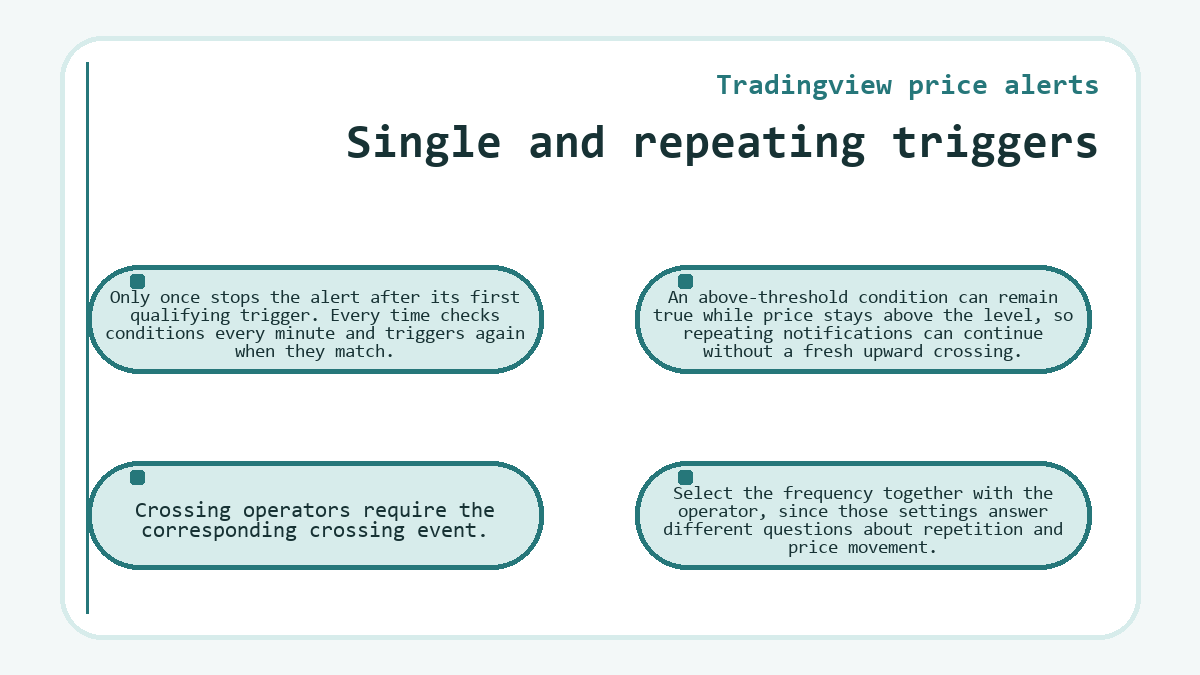
Only once stops the alert after its first qualifying trigger. Every time checks conditions every minute and triggers again when they match. An above-threshold condition can remain true while price stays above the level, so repeating notifications can continue without a fresh upward crossing. Crossing operators require the corresponding crossing event. Select the frequency together with the operator, since those settings answer different questions about repetition and price movement.
Conditions tied to a candle interval
A horizontal-line alert provides an interval-dependent alternative when you need a price level evaluated with a Once per bar close setting. Changing the chart interval does not make an ordinary price alert wait for a candle close. Indicator alerts also use an interval, and their values can change while a candle forms. Existing Pine Script indicator alerts retain the inputs saved at creation; changing those inputs on the visible chart does not update the running alert.
Can alerts keep working after you close the chart?
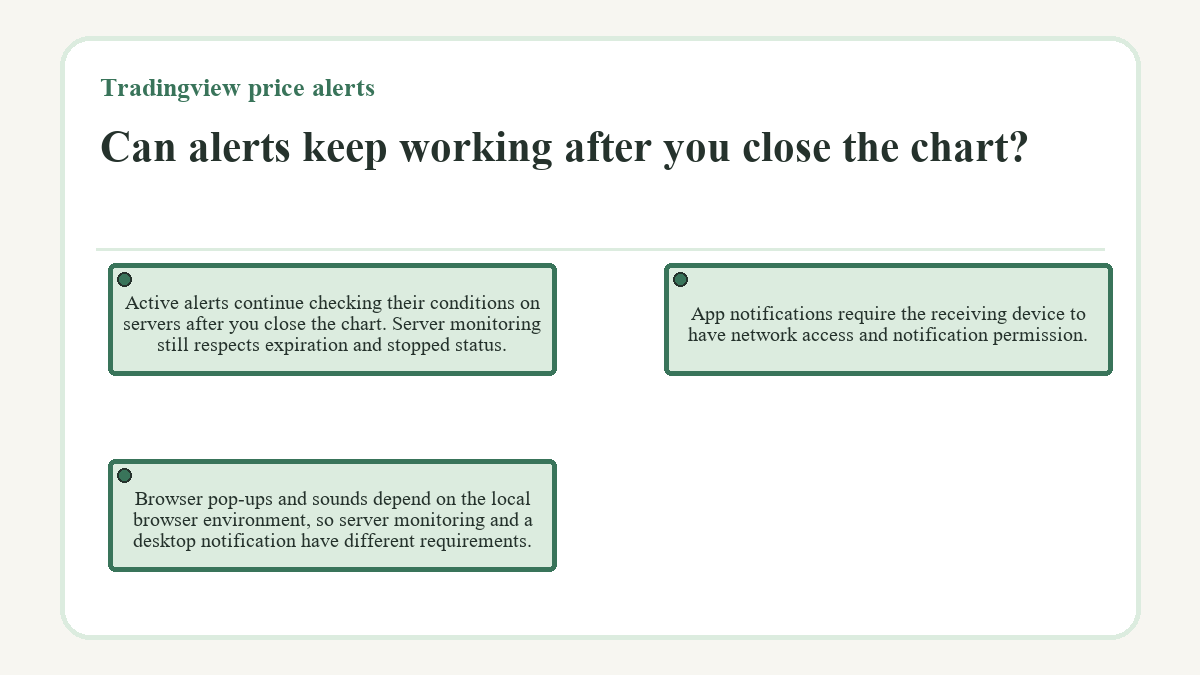
Active alerts continue checking their conditions on servers after you close the chart. Server monitoring still respects expiration and stopped status. App notifications require the receiving device to have network access and notification permission. Browser pop-ups and sounds depend on the local browser environment, so server monitoring and a desktop notification have different requirements.
Notification delivery and recorded triggers
Notification actions route an alert event to your phone, browser, email or an external application through the delivery options that you enable. The destination does not change the price condition.
Phone, browser and email settings
Mobile delivery requires the app, sign-in to the account that owns the alert and permission to send push notifications. Enable the app-notification option for the alert itself. Browser pop-ups require desktop notification permission, while email delivery uses the address in your profile. An alert name and message help identify the event among other notifications. Including the intended level and direction in the message gives the trigger context, especially when several rules monitor the same crypto symbol.
A trigger record and a received notification establish different events. The alert log helps separate detection from delivery.
Alert status and webhook delivery
The alert manager shows active alerts and reasons for stopped status, including expiration, manual stopping or an Only once trigger. Its controls let you edit, stop, resume or delete saved alerts. The log records triggered alerts. A webhook sends the alert message to an external application through an HTTP POST request. Webhook alerts require two-factor authentication on your account. Keep passwords and login credentials out of the message. The log's Webhook status field helps identify delivery failures. Successful delivery alone does not establish that an external trading service accepted or filled a crypto order.
Choosing an existing condition or a new crossing
In this hypothetical setup, a crypto symbol's price is 126.68 and the alert threshold is 125.48, in quote-currency units. Assume both values fit the symbol's tick size and their difference exceeds one minimum tick. App delivery is enabled and you want one notification without a webhook or trading integration.
The price is 1.20 quote-currency units above the threshold. Greater than matches that existing price condition; Crossing up waits for a new approach from below. Before pressing Create, you can adjust the operator or cancel the draft. Select Only once and confirm the settings before activating the alert.
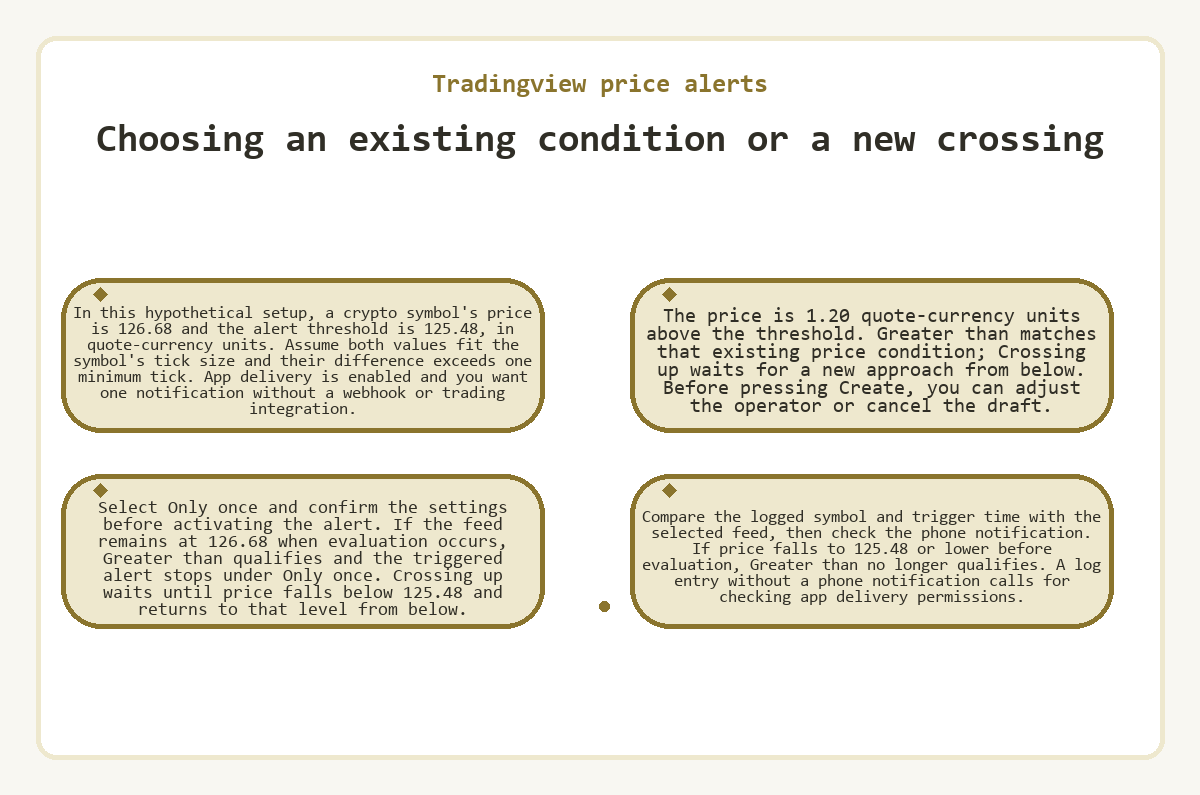
If the feed remains at 126.68 when evaluation occurs, Greater than qualifies and the triggered alert stops under Only once. Crossing up waits until price falls below 125.48 and returns to that level from below. Compare the logged symbol and trigger time with the selected feed, then check the phone notification. If price falls to 125.48 or lower before evaluation, Greater than no longer qualifies. A log entry without a phone notification calls for checking app delivery permissions.
Expiration and separate alert allowances
Scheduled expiration stops monitoring when the configured time arrives, and your subscription determines active-alert allowances and open-ended availability. An open-ended setting removes scheduled expiration, but it is unavailable for watchlist alerts. An alert also deactivates for inactivity when it is over a year old and has neither triggered nor been edited for over a year. Inspect the saved expiration rather than assuming every alert lasts indefinitely. Price, technical and watchlist alerts have separate allowances. A single-symbol alert with one fixed-threshold condition under Price uses the price-alert allowance; a condition attached to a drawing or indicator uses the technical-alert allowance.
What to know about Tradingview price alerts
Can I include the symbol and exchange in a price-alert message?
Price-alert messages can include {{ticker}} and {{exchange}} placeholders, which supply the monitored symbol and its exchange when the alert triggers. These values help identify the feed behind a notification. Ordinary text can also describe your chosen threshold and direction without changing the condition.
Does Bar Replay trigger existing price alerts on historical candles?
Existing server alerts continue using real-time data during Bar Replay, so replayed historical candles do not drive their triggers. You also cannot create new server alerts during replay. A historical crossing on the displayed chart therefore does not establish that a live price-alert notification occurred.
Can a single alert monitor every symbol in my crypto watchlist?
A watchlist alert applies the same condition independently to each symbol in the selected list. It is a separate alert category with its own subscription allowance. Adding symbols extends its coverage, while removing symbols removes that coverage; an ordinary single-symbol price alert does not follow watchlist membership.
How can I export the history of triggered price alerts?
The alert log offers CSV export through its Options menu. Export the trigger records that you need for review or comparison with notification records. This export concerns logged alert events, so it does not serve as an exchange order history or a record of trading fills.
Is a percentage-move alert counted as an ordinary price alert?
Moving up % and Moving down % conditions count as technical alerts, even when they describe price movement. They measure a percentage change within a specified number of bars. Their bar-based calculation differs from a fixed price threshold, and they use the technical-alert allowance.
Where can I set an alternative email address for price notifications?
An alternative email address can receive price-alert messages after you add and verify it under Alerts delivery in Settings and billing.
What message format does a webhook alert send?
A webhook sends the alert message in the body of an HTTP POST request. Valid JSON produces an application/json content type; other messages use text/plain. The receiving application must understand the message fields, and the correct content type alone does not confirm successful delivery or order execution.
When can a candle-close price-level alert arrive later than the candle close?
A candle-close alert can trigger late when the server waits for the next trade to confirm that the previous bar has ended. Sparse trading or delayed trade data can postpone that confirmation. Once per bar close requires bar-close confirmation before an alert can trigger; it does not guarantee when a notification arrives.
last updated