 Tradingview
Tradingview Paper Trading lets you practice crypto orders with virtual funds
Tradingview Paper Trading lets you place simulated crypto orders, manage positions and practice sizing with virtual funds. The order ticket controls quantity, order type and exit levels, while the account manager records fills and profit or loss. Your practice account uses live market data and holds simulated positions, with no real exchange funds at stake.
Useful practice connects an order's settings with the exposure that it creates. A market found through a crypto screener or monitored with price alerts still needs its own quantity, entry conditions and exit instructions in the simulator.
Margin requirements can prevent a simulated crypto order from filling even when its price condition has been met.
Connecting Paper Trading and correcting pending orders
Paper Trading connects through the trading controls in Supercharts, and unfilled orders remain editable before execution. The Trade button opens the connection choices; the Trading Panel also provides access to Paper Trading. The selected account name identifies the account receiving an order. The order ticket carries the buy or sell direction, quantity and required prices. A chart projection prepares those parameters visually without creating an executed trade.
An incorrect pending order calls for an edit or cancellation of that order. In confirmation mode, chart edits remain provisional until you confirm them; Discard abandons unconfirmed edits. Canceling a pending order does not undo an existing position. Once an order has filled, changing exposure requires a position-management action. One-click trading sends requests to place, modify or cancel orders or close positions immediately, without a confirmation preview.
Price conditions and tradable crypto symbols
A visible crypto chart does not guarantee an executable paper order because the simulator must support the selected symbol. Synthetic symbols that Tradingview calculates and marks with a purple label beside the market status cannot be traded in Paper Trading. Symbol Search shows the instrument type beside its data feed. A ticker alone does not establish which instrument, quotation currency or feed you selected.
A pending instruction remains unfilled while its price condition stays unmet. A limit price sets the maximum buy price or minimum sell price. A stop price activates a market instruction when reached. Neither a drawn line nor a displayed chart price proves that an order filled. The order record supplies that status.
Bid and ask prices explain some differences between chart prices and paper results. In most cases, the simulator buys at the ask and sells at the bid. The ask is the quoted selling price available to a buyer; the bid is the quoted buying price available to a seller. The chart's last traded price records a different event.
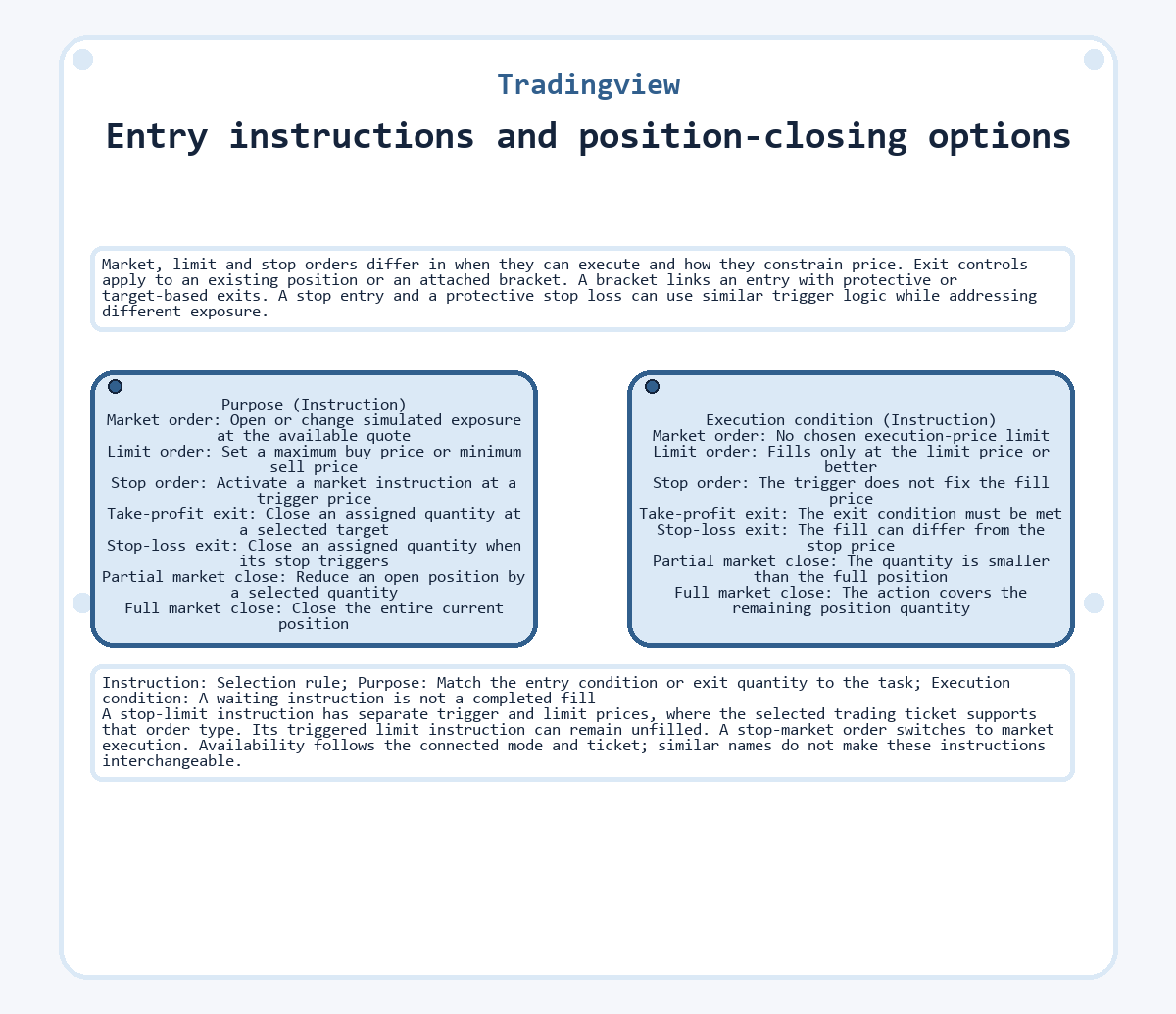
Entry instructions and position-closing options
Market, limit and stop orders differ in when they can execute and how they constrain price. Exit controls apply to an existing position or an attached bracket. A bracket links an entry with protective or target-based exits. A stop entry and a protective stop loss can use similar trigger logic while addressing different exposure.
| Instruction | Purpose | Execution condition |
|---|---|---|
| Market order | Open or change simulated exposure at the available quote | No chosen execution-price limit |
| Limit order | Set a maximum buy price or minimum sell price | Fills only at the limit price or better |
| Stop order | Activate a market instruction at a trigger price | The trigger does not fix the fill price |
| Take-profit exit | Close an assigned quantity at a selected target | The exit condition must be met |
| Stop-loss exit | Close an assigned quantity when its stop triggers | The fill can differ from the stop price |
| Partial market close | Reduce an open position by a selected quantity | The quantity is smaller than the full position |
| Full market close | Close the entire current position | The action covers the remaining position quantity |
| Selection rule | Match the entry condition or exit quantity to the task | A waiting instruction is not a completed fill |
A stop-limit instruction has separate trigger and limit prices, where the selected trading ticket supports that order type. Its triggered limit instruction can remain unfilled. A stop-market order switches to market execution. Availability follows the connected mode and ticket; similar names do not make these instructions interchangeable.
Position size, stop distance and margin
Position sizing connects trade quantity with the monetary effect of a price move. The order ticket offers quantity inputs in units, currency value and percentage of balance. It also offers risk-based sizing tied to a stop loss. For simple unit-based exposure, quantity multiplied by entry-to-stop distance gives the price-risk amount in the instrument's quotation currency before costs. That amount assumes an exit at the chosen stop price, which a stop-market trigger does not guarantee. Futures calculations additionally require the contract's point value.
Margin measures the funds required to support exposure. It differs from the loss implied by the stop distance.
Leverage changes the notional exposure that account funds can support. The ticket displays trade value, available margin and tick value. The simulator will not execute an order when its required margin exceeds available margin. That check occurs at execution, so an earlier preview cannot establish that funds will remain sufficient. Increasing position quantity also increases the monetary effect of a given price move, regardless of the leverage setting.
Net positions and paired exit quantities
Paper Trading combines filled orders for the same symbol into a single position. The Positions tab therefore describes combined exposure, while the order history preserves separate executions. Entries in the same symbol do not become independently managed positions within that account. A partial close reduces the shared position's quantity, and a full close removes its remaining exposure.
Multiple exit levels divide an order or position's quantity across paired take-profit and stop-loss orders. The Exits dialog supports up to four paired levels and displays each level's share of the main quantity. Executing either exit cancels its counterpart; deleting either part also removes the other. The simulator does not execute the portion of exit allocations that exceeds 100% of the main quantity. Setting the stop losses at the same price retains paired exits while allowing different profit targets. Exit allocations control how much closes at each level, rather than creating additional independent positions.
How does an open crypto position affect equity?
An open crypto position changes equity through its unrealized profit or loss. Account balance represents booked funds, while equity includes unrealized results. An open gain can increase equity before the position appears among closed trades.
Unrealized profit or loss moves with open exposure. Realized profit or loss comes from closed positions.
The profit calculation uses the price for closing the relevant side. A long position compares the bid with its average fill price. A short position compares its average fill price with the ask. A bid-ask spread can therefore produce negative unrealized profit immediately after entry, even without a visible change in the last traded price.
Available funds and account margin answer a separate question: how much capacity remains and how much supports open exposure. Equity alone does not show the funds available for a new order. The account manager displays those amounts separately.
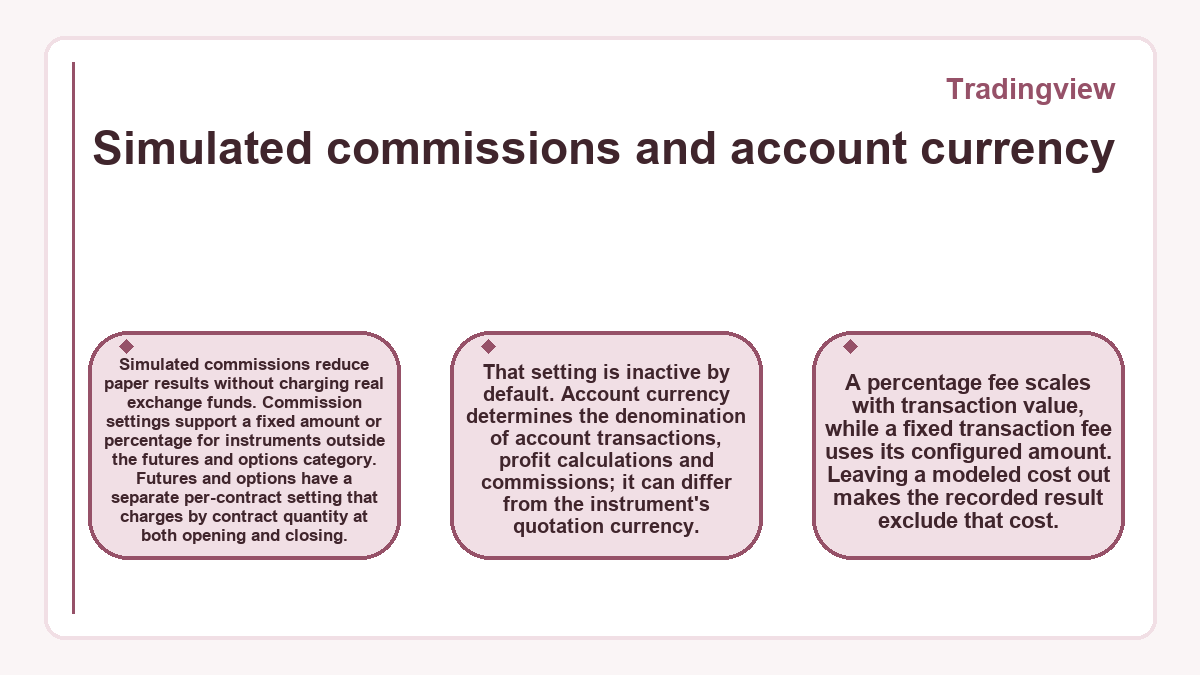
Simulated commissions and account currency
Simulated commissions reduce paper results without charging real exchange funds. Commission settings support a fixed amount or percentage for instruments outside the futures and options category. Futures and options have a separate per-contract setting that charges by contract quantity at both opening and closing. That setting is inactive by default. Account currency determines the denomination of account transactions, profit calculations and commissions; it can differ from the instrument's quotation currency. A percentage fee scales with transaction value, while a fixed transaction fee uses its configured amount. Leaving a modeled cost out makes the recorded result exclude that cost.
Trade records before an account reset
The account manager separates order records from closed-position results. History contains filled, rejected and canceled orders. Account history records closed positions, their entry and exit prices and realized profit or loss. The Trading journal provides textual order information and times. CSV export supplies a separate copy of trading data for reviewing executions outside the panel.
Resetting a paper account deletes its transaction history, active orders and open positions. Exporting records before a reset preserves a copy for later review. Changing an existing account's currency uses a reset, while creating a new account allows another currency without clearing the original account. Results recorded after the reset therefore start from the new account configuration.
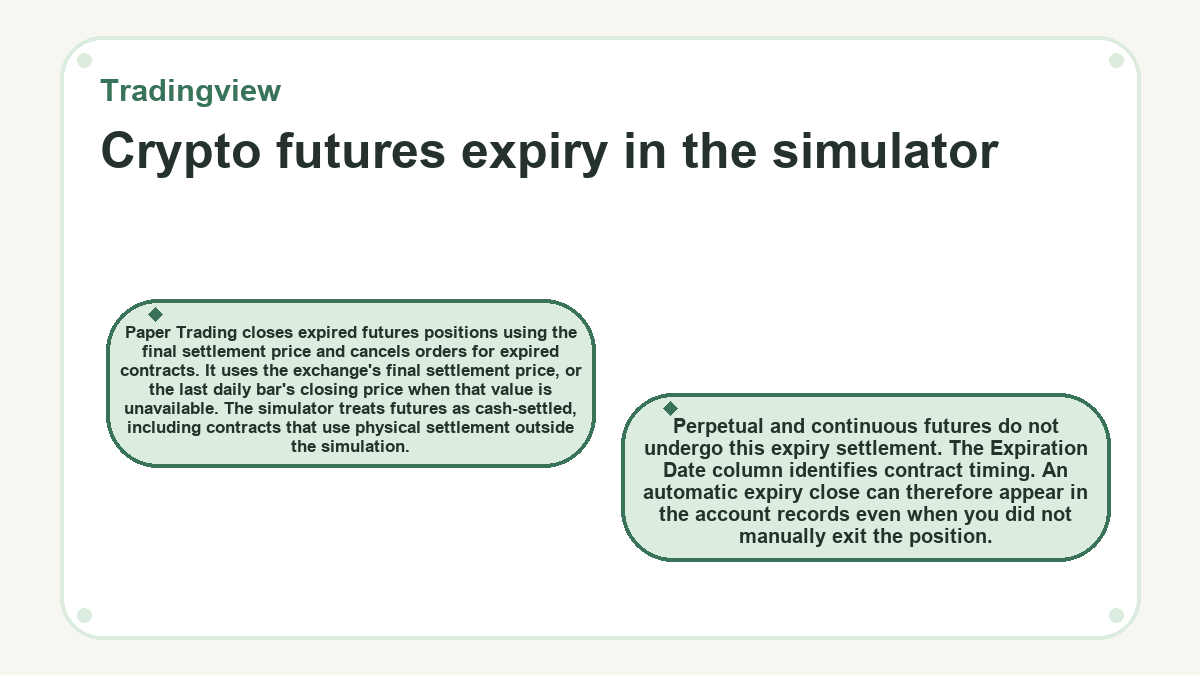
Crypto futures expiry in the simulator
Paper Trading closes expired futures positions using the final settlement price and cancels orders for expired contracts. It uses the exchange's final settlement price, or the last daily bar's closing price when that value is unavailable. The simulator treats futures as cash-settled, including contracts that use physical settlement outside the simulation. Perpetual and continuous futures do not undergo this expiry settlement. The Expiration Date column identifies contract timing. An automatic expiry close can therefore appear in the account records even when you did not manually exit the position.
Worth knowing
Is crypto Paper Trading available with a free account?
Paper Trading is available with a free account, including practice with supported crypto instruments. It uses virtual funds and does not require a funded brokerage account. Subscription features can change the charting tools available around the simulator, but a paid plan is not required for basic paper orders. Symbol eligibility remains a separate condition: a chart that you can view may represent an instrument that the simulator cannot trade.
Can I keep separate paper accounts for different crypto practice methods?
Multiple Paper Trading accounts let you keep different practice methods in separate simulated accounts. Accounts can have different starting balances, currencies and leverage settings. The account selector identifies which account you are using for an order. Separate accounts provide separation between practice records; they do not split an existing position into independently managed entries. Differences in leverage or modeled commissions also change the conditions behind each account's results.
How do crypto paper orders behave during Bar Replay?
Paper Trading orders continue to use real-time data while Bar Replay displays historical candles. Quotes in the trading panel also remain tied to real-time data. A past price visible on the replayed chart therefore does not become the execution price for an ordinary paper order. Replay Trading provides separate controls for historical trading practice. Choosing that mode keeps historical entries and exits distinct from the normal Paper Trading account.
Where can I change the leverage for my crypto paper orders?
Crypto leverage belongs to the Paper Trading account settings for its asset class. Those settings allow a selected ratio or custom multiplier, which governs the simulated exposure that funds can support. The chosen asset-class setting applies to relevant orders in that account. It does not assign leverage to a connected live exchange account. Actual execution still requires enough available margin when the simulator evaluates the order.
Does Paper Trading offer Good Till Cancelled crypto orders?
Paper Trading does not offer Good Till Cancelled orders, often abbreviated GTC. The order ticket's time-in-force control specifies the available duration for a pending instruction. A chosen duration determines when an unfilled order expires; it does not change the order's price conditions. This restriction concerns the Paper Trading simulator and does not establish the duration choices that a separate connected trading provider offers.
Are crypto exit levels reusable through order presets?
Configured exit levels can be saved in an order preset together with other order parameters. A preset stores a reusable configuration, so repeated practice does not require rebuilding the same exit structure. Its quantity and price fields still need to match the order being prepared. Saving a preset records settings; it does not place the order or create a position. The order's actual status appears in the account records.
last updated